
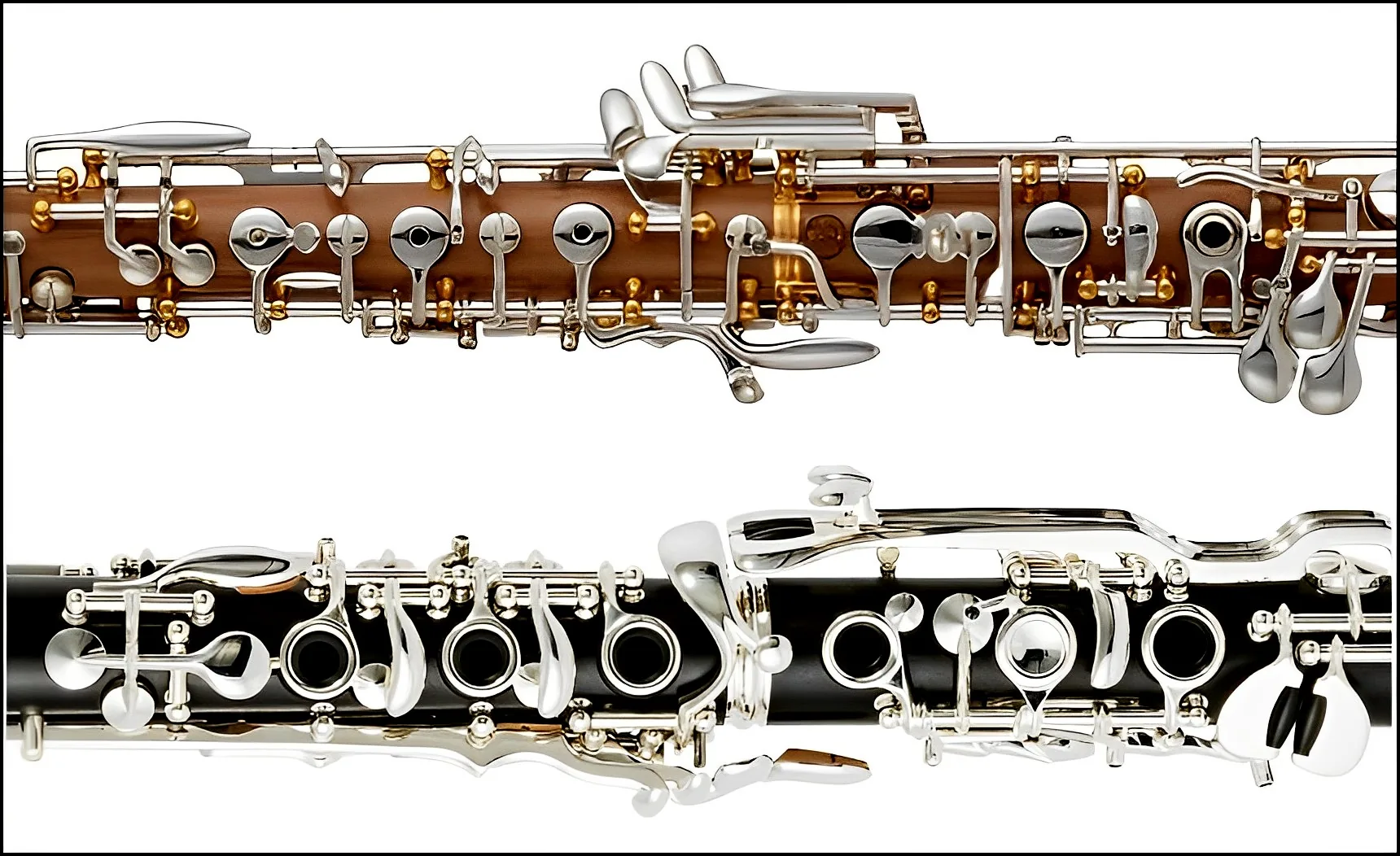

Wind instruments hold an essential place in the musical world and offer tremendous variety. The clarinet and oboe, two members of the woodwind family, each have distinctive characteristics.
Despite their similarities, they have significant differences, particularly in their reed systems, bores, and sounds. Choosing between the clarinet and oboe depends on several criteria.
These include range, musical styles, age, body type, and budget. Every factor matters to the musician.
Introduction: the clarinet and oboe, two distinct wind instruments
Wind instrument families are classified according to how they produce sound, rather than the material from which they are made. Woodwinds produce sound using either a single or double reed. Brass instruments produce sound through the vibration of the player’s lips in the mouthpiece. The clarinet and oboe belong to the woodwind family despite their metallic-looking keywork.
Definition and classification of wind instruments
Woodwinds include single-reed instruments, such as the clarinet, and double-reed instruments, such as the oboe. This difference in reed design affects their sound and acoustic properties. Brass instruments, such as the trumpet, produce sound through the vibration of the player’s lips, using a different mechanism from woodwinds.
Woodwinds and brass: two separate instrument families
- The clarinet has a warm, mellow sound, a single reed, and a cylindrical bore.
- The oboe, a double-reed instrument, was developed in France early in the reign of Louis XIV.
- The flute, the highest-pitched instrument, has seen its repertoire expand since the seventeenth century.
- The saxophone, invented by Adolphe Sax in 1842, has a single-reed mouthpiece fitted to a conical metal tube.
- The bassoon, which appeared in Italy in the late sixteenth century, consists of a long tube traditionally made from fine wood.
- The brass family includes wind instruments that produce sound through the vibration of the player’s lips, such as the trumpet and trombone.
Fundamental differences between the clarinet and oboe
The main difference between the clarinet and oboe lies in their reeds. The clarinet has a single reed. The oboe has a double reed. This difference affects their sound, with the oboe producing a richer tone.
Their bores also differ in shape. The clarinet has a cylindrical bore, while the oboe has a conical bore. This distinction influences their sound and timbre. The clarinet has a wider range, extending to approximately three octaves and a sixth. The oboe’s range is somewhat narrower.
The oboe has a “nasal” sound, while the clarinet has a “rounded” sound.
| Characteristic | Clarinet | Oboe |
|---|---|---|
| Reed | single reed | double reed |
| Bore | cylindrical | conical |
| Range | 3 octaves and a sixth | Fewer than 3 octaves |
| Sound | “Rounded” sound | “Nasal” sound |

“The difference in bore between the clarinet and oboe has a significant impact on their respective sound characteristics.”
Oboe vs. Clarinet: Which Instrument Should You Choose?
The clarinet and oboe have important differences. The clarinet has a wider range, making it versatile and suitable for many musical styles, from classical music to jazz. The oboe is more commonly used in classical and symphonic repertoire. Its distinctive timbre and narrower range are particularly well suited to these genres.
Instrument ranges and registers
The clarinet can play both low and high notes, giving it a wide variety of expressive possibilities. It is therefore ideal for many genres, from classical music and jazz to klezmer.
The oboe has a more limited range. It is frequently used in classical and symphonic repertoire. Its distinctive timbre makes it particularly suitable for Romantic works and concert-band scores.
Musical styles associated with each instrument
- The clarinet is highly versatile. It is at home in many musical styles, from classical music and jazz to klezmer.
- The oboe is more commonly used in classical and symphonic repertoire. Its timbre and range are especially well suited to these genres.
- The oboe can also be used in certain jazz or folk styles, although this is less common.
Choosing between the clarinet and oboe depends on your preferences and musical goals. The clarinet is more versatile. The oboe stands out for its distinctive timbre in classical and symphonic works.
Practical considerations when choosing an instrument
Choosing between the clarinet and oboe is not based solely on technical criteria. The musician’s age and size must also be considered. The oboe is heavier and may be better suited to taller players. The lighter clarinet is ideal for younger or smaller players.
The musician’s age and build
The choice of instrument also depends on the musician’s age and size. Young beginners often find the clarinet easier to handle. The oboe requires greater strength and breath control, making it more suitable for experienced or taller musicians.
Instrument budget and cost
Budget plays a crucial role in choosing an instrument. The clarinet is often less expensive than the oboe, especially at beginner level. A beginner can readily find an affordable clarinet. The oboe generally costs more, particularly when purchasing a high-quality new instrument.
In conclusion, choosing between the clarinet and oboe depends on several factors. Age, size, and budget are essential considerations. Each instrument presents its own advantages and challenges. The choice of a first instrument should be carefully considered to encourage successful, lasting musical development.
Conclusion
Choosing between the clarinet and oboe requires several factors to be considered. The technical and musical differences between these instruments are significant. The clarinet has a wide range and versatility that allow it to adapt to many musical styles.
The oboe has a rich sound thanks to its double reed and conical bore. It is frequently used in classical music.
The musician’s budget, age, and build all influence the choice of wind instrument. The oboe is uncommon and expensive, whereas the clarinet is more accessible, allowing more people to get started.
Depending on your musical preferences, skill level, and budget, either the clarinet or the oboe can be a good choice. What matters most is finding an instrument that brings you pleasure and helps you progress.
FAQ
What are the main differences between the clarinet and oboe?
What are the families of wind instruments, and how are these instruments classified?
How do the ranges and registers of the clarinet and oboe differ?
What musical styles are associated with the clarinet and oboe?
What practical considerations should be taken into account when choosing an instrument?
How can the main differences between the clarinet and oboe be summarized?
Source links
- https://austinsymphony.org/education-community/instruments/
- https://createmusic.org.uk/for-children-and-young-people/lessons-at-school/the-instruments-we-offer/oboe/
- https://en.wikipedia.org/wiki/Clarinet_family
- https://orchestramap.carnegiehall.org/?active=clarinet&mapType=instruments
- https://newhavensymphony.org/wp-content/uploads/2017/07/2017-YPC-Teacher-Resource-Guide.pdf
- https://www.interlochen.org/music/academy/clarinet
- https://researchguides.csuohio.edu/woodwinds
- https://www.pbs.org/video/the-clarinet-and-its-sound-a0gfjm/
- https://www.allnewton.org/instrument-families/woodwinds
- https://createmusic.org.uk/for-children-and-young-people/lessons-at-school/the-instruments-we-offer/clarinet/
- https://austinsymphony.org/education-community/instruments/
- https://www.kcsymphony.org/wp-content/uploads/2023/09/23KCS_EDU_YPC_3.pdf
- https://hop.dartmouth.edu/sites/hop.prod/files/hop/imaniwinds-studyguide-web-new.pdf
- https://www.interlochen.org/music/academy/clarinet