
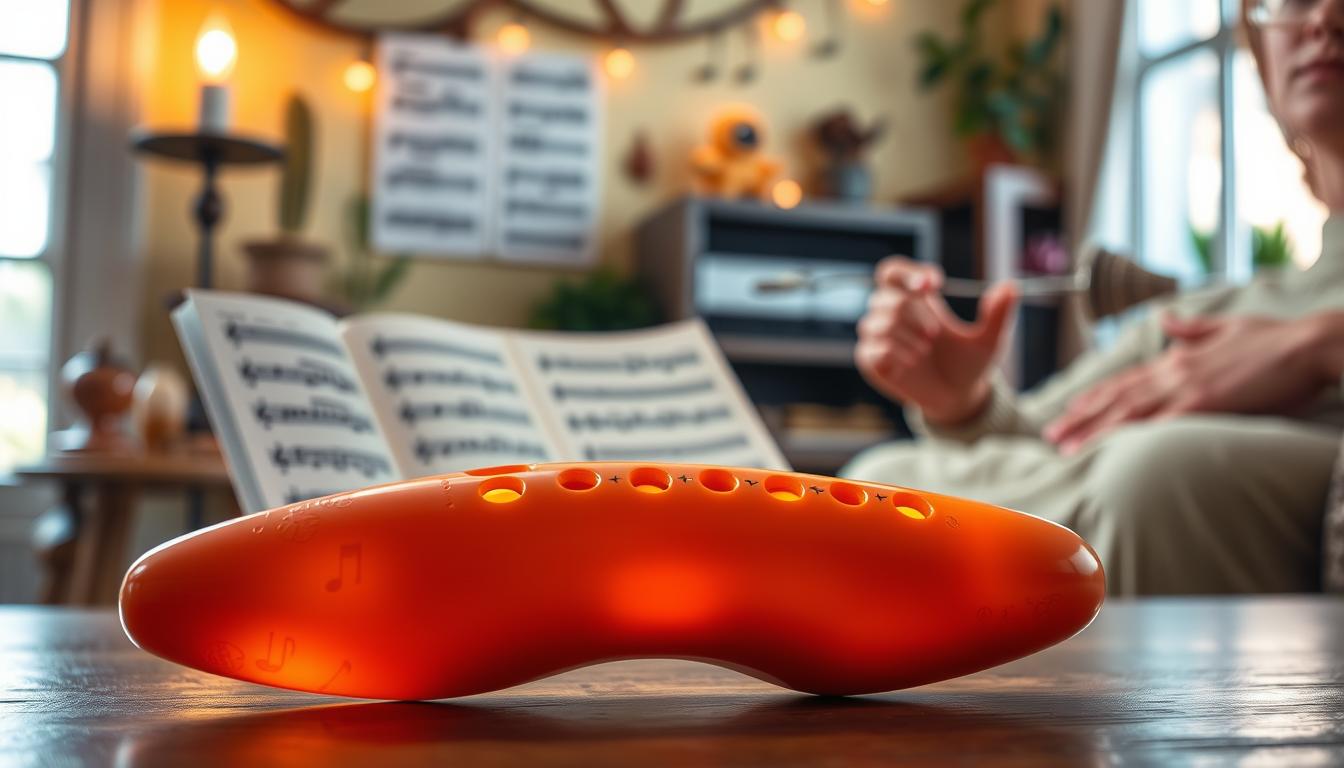

The ten-hole model remains a simple and effective choice for beginners. Its intuitive fingering makes it easier to learn scales and tablature. It is comfortable for small hands and players who want to progress quickly.
Build quality has a major influence on tone. Recognized brands such as STL Ocarina and Musique Terre offer ceramic, terracotta, and plastic models. The choice often depends on your budget and intended use, whether traveling or playing at home.
In this article, we examine how the number of holes affects range, tuning, and learning methods. You will also find advice on checking intonation against the A440 reference pitch, as well as return conditions and manufacturer warranties.
In short, this type of instrument combines ergonomics, quality, and a reasonable price. It lets you play many pieces within the first few weeks.
10-Hole Ocarina: Why This Format Is the Most Popular
Its design combines musical range with ergonomic comfort, helping new players progress quickly. The balance between range and straightforward fingering makes this instrument accessible to beginners while remaining useful for experienced musicians.
Versatility and comfort account for much of its success. These models are suitable for folk performances, video-game music covers, and educational exercises. Their shape generally accommodates different hand sizes, reducing fatigue.
Whether it is made from ceramic or plastic affects the tone, but the principle remains the same: prioritize simplicity without sacrificing musical range. Comparing different ocarinas shows that this compromise offers an excellent balance between ease of use and performance.
- Wide range without excessive complexity.
- Thoughtful ergonomics for most hand sizes.
- Versatility for acoustic styles and video-game music.
“A good starting point for discovering the subtleties of terracotta or plastic flutes.”
To explore different models and buy from France, browse our instrument collection.
Understanding the Logic of the Holes and Musical Range
The design of the holes determines how pitches progress and how easily notes can be reached on a transverse instrument.
Twelve-hole models provide approximately 22 notes, giving them a range of about 1.5 octaves. That is enough for both simple tunes and more complex themes.
Accessing the Notes
The principle is simple: uncovering a hole raises the pitch. The holes are arranged in an easy-to-follow progression.
Good tuning ensures stable intonation across the entire range. Your fingers must completely cover the holes to prevent air leaks.
Progressive Fingerings
The progressive fingering method makes tablature intuitive for beginners to read.
Each note is produced with a precise combination. This makes the sequence of notes in a melody feel natural and easy to memorize.
“Understanding how each hole changes the fundamental note is the first step toward mastering this wind instrument.”
For a clear fingering chart and exercises, consult our 12-hole fingering guide.
| Feature | 6–8-hole model | 12-hole model |
|---|---|---|
| Approximate number of notes | 12–15 | ≈ 22 |
| Range | About 1 octave | About 1.5 octaves |
| Beginner accessibility | Very easy | Easy, with more possibilities |
| Uses | Nursery rhymes, learning | Varied repertoire, film themes |
Comparing Six- and Eight-Hole Models
Compact and technically demanding, six- and eight-hole versions require a different fingering approach. John Taylor demonstrated in the 1960s that a precise method could produce 17 to 18 notes with only a few holes.
Portability and range: these small instruments are appealing because of their size. They remain convenient for playing while traveling, but offer a narrower range. Without transposition, your choice of pieces is often limited.
Memorizing fingerings becomes crucial. Accidentals require combinations that are not always intuitive. For a beginner, learning can be more demanding than on larger ocarinas.
- Exceptional compactness for playing while traveling.
- Fewer holes = a more limited range.
- Variable quality and prices depending on the brand.
“The charm of these small flutes conceals a demanding technique; Taylor’s method remains a benchmark for maximizing the number of notes.”
To try and compare different models, browse our compact collection.
Advantages of the Transverse Design for Beginners
The modern transverse design makes learning feel more natural for anyone beginning with a wind instrument. Inspired by Giuseppe Donati in the nineteenth century, it encourages a comfortable hand position.
Playing ergonomics: the arrangement of the holes guides each finger toward its proper position. Fingers settle over the holes more easily, reducing fatigue during long sessions.
Unlike John Taylor’s method, the transverse system follows a linear progression. Each uncovered hole raises the pitch by one step, simplifying both fingering and tablature reading.
- Stable response, whether the instrument is ceramic or plastic.
- Sufficient range for playing many notes without complex fingerings.
- Reliable tuning thanks to accurately drilled holes made by the manufacturer.
“Its ease of use explains why this design is so popular with beginners.”
By choosing a transverse model, you are investing in a durable educational instrument. Its price often reflects this precision, while consistent notes help develop your musical ear from the very first lessons.
Exploring Multi-Chamber Instruments for Advanced Players
Multi-chamber instruments open up rare tonal possibilities intended for advanced players.
Two main families stand out among these models: the Asian system and the Pacchioni design.
Asian System
The Asian system emphasizes continuity between chambers. The chambers follow one another without interruption. This gives musicians smooth transitions and nearly continuous access to the notes.
Pacchioni System
The Pacchioni system uses overlapping chamber ranges. This choice evens out the tone and strengthens sonic consistency across several octaves.
Models made from ceramic or plastic can reach two octaves or more. With two to four chambers, they greatly expand the available performance possibilities.
“These complex ocarinas demand complete breath control and advanced coordination.”
- Each chamber functions like a small independent instrument.
- Memorizing fingerings becomes essential.
- The extended range opens the door to classical transcriptions.
| Criterion | Asian system | Pacchioni system |
|---|---|---|
| Transition | Continuous | Overlapping |
| Tone | Consistent | Even across several octaves |
| Required technique | Controlled breath | Advanced coordination |
Choosing the Ideal Range for Your Voice
Match your instrument’s range to your voice so that you can play without strain and retain a natural tone.
The soprano produces a clear sound and is easy to carry. It suits high voices and fast melodies. Lower-pitched models add depth and are better suited to lower registers.
Multi-chamber instruments increase the number of available octaves. They are useful if you want to sing and play or vary your repertoire without changing instruments.
For a beginner, a transverse ocarina in C remains a safe choice. It makes fingering charts easier to read and provides tuning well suited to learning notes.
Try several models in a store or order them online to make sure they suit your hand size and require a comfortable level of breath pressure. Matching your voice to the instrument’s range prevents unnecessary strain.
“A good initial choice will let you progress without replacing your instrument too soon.”
- Practical advice: choose a range compatible with your vocal register.
- Tip: favor an instrument with intuitive fingering so you can progress quickly.
Comparing Materials: Ceramic and Plastic
Ceramic and plastic differ in their tone and practical characteristics.
Ceramic offers a warm tone and rich projection. It appeals to musicians seeking a beautiful tonal color for recording or indoor performances.
Brands such as STL Ocarina and Musique Terre offer high-quality clay models. These instruments often feature refined designs, but require careful maintenance.
Durability and Maintenance
Plastic, particularly the material used for Night by Noble models, stands out for its durability. Instruments made from it withstand impacts and retain their tuning while traveling.
A terracotta instrument requires more careful maintenance. Plastic, by contrast, is easy to clean with lukewarm water.
- The same range is available with both materials; the tactile feel differs.
- Your choice depends on your budget and intended use: in the studio or while traveling.
- Investing in a recognized brand ensures better quality and good value for the price.
“Ceramic captivates with its appearance; plastic wins out for practicality.”
| Criterion | Ceramic | Plastic |
|---|---|---|
| Tone | Warm, rich | Clear, stable |
| Durability | Fragile material | Highly durable material |
| Maintenance | Delicate care | Easy cleaning |
The Importance of Intonation and Reference Pitch
An instrument’s intonation determines its musical value. The A440 standard remains the international tuning reference. A reputable manufacturer should adhere to this standard across the instrument’s entire range.
A poorly tuned ocarina forces the player to compensate with breath pressure. This alters the tone and slows learning. Check the tuning with an electronic tuner as soon as the instrument arrives.
The precision with which the holes are drilled determines note stability and the quality of the playable scale. Octaves must sound in tune, without drifting, if the instrument is to be played in an ensemble.
An effective quality-control process removes defective models before sale. Stable pitch across every register remains the hallmark of rigorous design.
“Intonation directly influences how we perceive each note and develop our musical ear.”
- Check the tuning with a tuner.
- Review the scale and tablature to ensure accurate fingering.
- Choose a recognized manufacturer to ensure quality.
To improve your fingerings and check your intonation in practice, try our exercises on essential fingerings.
Advice for Avoiding Marketplace Pitfalls
An impulse purchase from a major online platform may leave you with a poorly tuned, low-quality instrument.
Avoid general-purpose marketplaces for this type of purchase. Quality control is often nonexistent.
Favor specialist retailers such as STL Ocarina or Musique Terre. They guarantee the instruments’ provenance and intonation and provide detailed technical specifications.
- An unusually low price often signals a toy that cannot produce stable notes.
- Check the return policy before buying so you can send the instrument back if its tuning is poor.
- Request a fingering chart and a tuning warranty, especially for a soprano or alto model.
- Check the quality of the drilled holes: this is what distinguishes a genuine instrument from a decorative object.
“Choosing specialists saves you many disappointments and helps you make the most of your musical budget.”
For additional practical advice, consult our six-hole buying guide, which will help you compare models, materials (ceramic and plastic), and brands before making your final choice.
Practical Guide to Buying Your Instrument in France
Buying your ocarina in France makes after-sales service, returns, and customer support easier. When choosing your first instrument, favor a seller who responds online or by phone.
Compare materials: ceramic and clay provide a warm tone, while plastic withstands travel better. Also consider the price and your budget before completing your purchase.
Specialist stores often offer beginner packages. These packages include a method book, a case, and a fingering chart to help you master the fingerings quickly and explore your instrument’s range.
Check the design, tuning, and build quality. A good soprano should be properly tuned to make learning easier and prevent unnecessary breath corrections.
- Compare models and prices.
- Read reviews and consult the technical specifications.
- Favor recognized brands such as STL Ocarina or Musique Terre.
Taking the time to try the instrument and ask the seller questions helps prevent unpleasant surprises.
If you have any questions or need assistance, please contact our team.
Conclusion
Ultimately, the balance between range and fingering guides a musician’s choice. Ten- and twelve-hole models suit beginners because of their straightforward fingering logic. The transverse design, inherited from Giuseppe Donati, makes the instrument easier to hold and tablature easier to learn.
As you progress, instruments with multiple chambers provide more octaves, but require greater technical skill. Keeping your instrument properly tuned and choosing a reliable brand such as STL Ocarina will improve your experience, whether the instrument is made from clay or plastic.
This article also discusses the contributions of John Taylor and modern standards. For a practical learning guide, follow this step-by-step tutorial and practice regularly to turn your interest into genuine musicianship.