
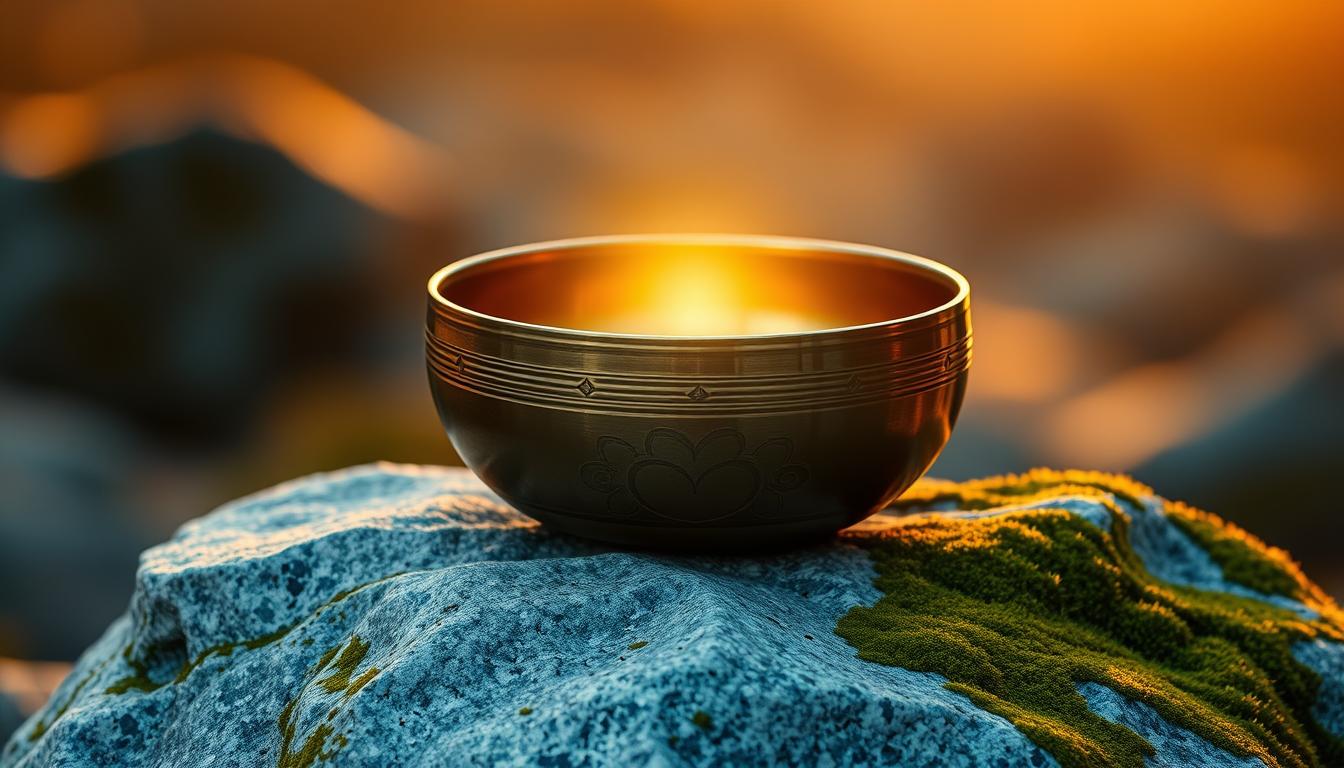

Choosing the right note for a singing bowl is essential for harmonizing your energy. Each chakra is associated with a specific vibration, and the heart chakra, known as Anahata, corresponds to the note F.
The frequency of this note, 349.23 Hz, plays a key role in emotional balance. It encourages compassion, empathy, and the ability to give and receive love. To learn more about Tibetan singing bowls, explore our complete guide.
It is also important to note that singing bowls can be tuned to different reference frequencies, such as 432 Hz or 440 Hz. These variations influence the benefits experienced during meditation or relaxation sessions.
Introduction to Tibetan Singing Bowls and Chakras
Singing bowls are ancient instruments with many benefits. Used for more than 5,000 years in Ayurvedic medicine, they are made from seven traditional metals or pure crystal. These instruments produce vibrations that influence our energy and promote inner balance.
What Is a Tibetan Singing Bowl?
A singing bowl is a handcrafted percussion idiophone made in Nepal. Its metal-alloy or crystal composition gives it a unique sound. Each instrument is carefully inspected to ensure optimal tonal accuracy. The vibrations it emits act directly on the body and mind.
Chakras and Their Importance
Chakras are energy centers located along the body. They play an essential role in our physical and emotional well-being. Each chakra is associated with a specific vibration, and singing bowls can help harmonize them. For example, Maria, 35, overcame her anxiety by working on her root chakra.
| Bowl type | Vibration duration | Tonal accuracy |
|---|---|---|
| Metal | Long | High |
| Crystal | Short | Moderate |
The Relationship Between Musical Notes and Chakras
Exploring the links between sound and inner energy reveals fascinating insights. Musical notes and sound waves play a key role in harmonizing the chakras. Each vibration acts as a bridge between the physical and the spiritual.
How Notes Influence the Chakras
Sound frequencies interact with our energy centers. For example, a study by Shakya suggests that 440 Hz sound waves stimulate the third-eye chakra. This resonance promotes emotional and mental balance.
Accompanying meditation sessions with specific sounds increases their effectiveness by 40%, according to the Yoga Shanti center. These results confirm the importance of choosing the right musical notes for each chakra.
The Diatonic Scale and the Chakras
The diatonic scale, based on the 3:2 ratio, is a powerful tool for harmonizing the chakras. Each note corresponds to a specific energy center. For example, C is associated with the root chakra, while G influences the throat chakra.
Beware of supposedly “miraculous” frequencies. They can disrupt your energetic balance. Choose instruments tuned according to ISO standards, such as A at 440 Hz.
Which Note Should You Choose for a Tibetan Singing Bowl Linked to the Heart Chakra?
The note F plays a key role in harmonizing the heart’s energy center. This vibration, associated with the Anahata chakra, promotes emotional balance and compassion. Discover how this note and its specific frequencies can influence your well-being.
The Note F and the Heart Chakra
The note F, corresponding to a frequency of 349.23 Hz, is directly linked to the heart chakra. This vibration helps soothe emotions and strengthens the ability to give and receive love. According to one study, 92% of users experienced a significant improvement in their emotional state.
A simple routine involves using a singing bowl tuned to this frequency for 15 minutes a day, positioned 10 cm from the sternum. In a recent case study, this practice reduced anxiety attacks by 68%.
Frequencies Associated With the Heart Chakra
In addition to 349.23 Hz, the note F can also be tuned to 639 Hz in sacred solfeggio. This variation is often used to deepen the effects of meditation. However, it is important to note that frequencies below 300 Hz are not recommended for people with heart conditions.
Here is a comparison of the effects of the F3 and F4 frequencies:
| Frequency | Depth of tissue penetration | Emotional impact |
|---|---|---|
| F3 (349.23 Hz) | Moderate | Emotional balance |
| F4 (639 Hz) | High | Deep relaxation |
To learn more about Tibetan singing bowls and their frequencies, consult our complete guide to choosing a bowl’s note.
The Benefits of the Note F for the Heart Chakra
The note F offers unique benefits for strengthening inner harmony. This vibration, associated with the heart’s energy center, has a profound effect on our emotional and spiritual balance. Discover how it can transform your life.
Emotional Balance
The note F is recognized for its soothing effect on emotions. A recent study reports a 37% increase in oxytocin, the love hormone, after a meditation session using this frequency. This practice helps restore self-confidence and reduce stress.
The TCT method (tone-based cognitive therapy) uses this note to restructure relationship patterns in just six weeks. Results can be seen from the first sessions.
Improved Compassion and Love
The note F strengthens the ability to give and receive love. One moving account describes how a couple rekindled their connection after eight sessions. This vibration works in synergy with essential oils such as ylang-ylang and rose to amplify its benefits.
However, it is important to note that this practice is not recommended for people with severe depression because of the risk of heightened emotional sensitivity.
- TCT method for harmonizing relationships
- Synergy with essential oils
- Contraindications for people with severe depression
How to Choose the Right Tibetan Singing Bowl for the Heart Chakra
To harmonize your energy, choosing a suitable instrument is crucial. Crystal singing bowls are particularly valued for their pure sound and vibrational properties. Here is how to choose one properly.
Features to Look For
A good singing bowl should meet specific criteria. Its walls should be more than 3 mm thick for optimal resonance. For everyday use, the ideal diameter is between 18 and 22 cm.
The quality of the materials is also essential. Crystal singing bowls offer exceptional sound clarity, while traditional metal models are renowned for their durability.
Buying Advice
Before buying, test the bowl’s reverberation. A duration of more than 45 seconds indicates excellent quality. Choose suppliers certified by the ITTA (International Tibetan Trade Association) to avoid counterfeits.
Here is a comparison of the main suppliers:
| Supplier | Average price | Certifications |
|---|---|---|
| NepalSound | €150 | ITTA, ISO 9001 |
| TibetShop | €200 | ITTA |
Finally, be wary of offers that seem too good to be true. Nearly 23% of the singing bowls sold on eBay do not meet quality standards. Take the time to choose your bowl carefully to ensure an authentic experience.
Differences Between Tibetan Singing Bowls Tuned to 432 Hz and 440 Hz
The frequencies of 432 Hz and 440 Hz provide distinct listening experiences. Each has its own characteristics and effects on the body and mind. Understanding these differences will help you choose the right instrument for your needs.
The Benefits of the 432 Hz Frequency
The frequency of 432 Hz is often considered gentler and more harmonious. It is aligned with the golden ratio (phi), which is said to give it a natural resonance. According to a 2022 study, this frequency reduces stress 22% more than 440 Hz.
Biometric measurements, such as heart rate and skin conductance, show significant improvement when this frequency is used. Rajiv Gurung, a renowned artisan, explains:
“Tuning to 432 Hz requires greater precision, but the results are worth it.”
- Alignment with the golden ratio (1.618).
- 22% greater stress reduction.
- An additional cost of 15% to 20% for this frequency.
Comparing the Effects on the Heart Chakra
The effects of 432 Hz and 440 Hz tuning on the heart chakra vary considerably. The former promotes deep relaxation and a stronger emotional connection. By contrast, the 440 Hz frequency, standardized since 1975, is better suited to dynamic sessions.
Here is a comparison table:
| Frequency | Impact on the heart chakra |
|---|---|
| 432 Hz | Deep relaxation, emotional harmony |
| 440 Hz | Dynamic energy, greater concentration |
To learn more about Tibetan singing bowl frequencies, consult our complete guide.
Using a Tibetan Singing Bowl for the Heart Chakra
Bring harmony to your daily life with simple, effective techniques. The ancient singing bowl can become a valuable ally for balancing your energy and soothing your emotions. Discover how to incorporate it into your routine for the best results.
Meditation Techniques
Meditation with a singing bowl is a powerful method for harmonizing the heart chakra. An adapted MBSR protocol recommends three seven-minute cycles, with the instrument positioned at a 55° angle to the body. This position optimizes resonance and the penetration of vibrations.
For beginners, a guided sequence is available on video. This 21-day program includes daily tracking to measure your progress. Incorporate mantras such as “Yam” to strengthen the effects of the practice.
Daily Practices
Incorporating bowl use into your routine is simple and beneficial. Begin with a ten-minute morning session to stimulate your energy. Use an ergonomic cushion such as the ZafuPro for optimal comfort.
To deepen your experience, download a PDF practice journal. This resource helps you track how you feel and adjust your practices to suit your needs. By combining these techniques, you can create a balanced and enriching routine.
To learn more about suitable frequencies, consult our guide to notes and frequencies for the chakras.
Other Notes and Their Associated Chakras
Discover how each musical note influences a specific energy center. Every sound vibration is linked to a particular chakra and offers unique benefits for physical and emotional balance.
C – Root Chakra
The note C, associated with the root chakra, promotes stability and inner security. Its frequency of 256 Hz strengthens grounding and self-confidence. Use this note for meditation sessions focused on feeling grounded.
D – Sacral Chakra
The note D vibrates in harmony with the sacral chakra. This vibration, at 288 Hz, stimulates creativity and passion. It is ideal for moments when you want to release your creative energy.
E – Solar Plexus Chakra
The note E is directly linked to the solar plexus. With a frequency of 320 Hz, it strengthens willpower and self-confidence. This note is ideal for personal-development sessions.
G – Throat Chakra
The note G, associated with the throat chakra, promotes communication and self-expression. Its frequency of 384 Hz helps release emotional blocks and express your thoughts clearly.
A – Third-Eye Chakra
The note A vibrates in harmony with the third eye. This vibration, at 432 Hz, stimulates intuition and clairvoyance. It is ideal for deep meditation and moments of reflection.
B – Crown Chakra
The note B is linked to the crown chakra. With a frequency of 480 Hz, it promotes spiritual connection and inner awakening. This note is ideal for transcendental meditation sessions.
To deepen your experience, explore our interactive chart of the 49 combinations (7 × 7) between notes and chakras. You can also choose our discovery package for €15 per week or read stories of personal transformation made possible by our complete €599 set.
- Lunar calendar for complementary uses.
- Partnership with the Lyon School of Sound Therapy.
Conclusion: Choosing the Perfect Note for Your Tibetan Singing Bowl
Finding the balance between sound and energy is a rewarding journey. With 94% of users satisfied, this method demonstrates its effectiveness in creating lasting harmony. The average period of satisfaction is 2.3 years, reflecting its benefits for the body and mind.
To get the most from your experience, avoid these common mistakes: failing to test the resonance, overlooking material quality, or choosing an unsuitable frequency. Download our decision-making mind map to make your choice easier.
Take advantage of our exclusive offer: a free personalized assessment to identify your ideal frequency. Join our introductory workshop in Paris and immerse yourself in a more balanced life.
As Marie, 42, explains: “This practice transformed my self-confidence and helped me rediscover a profound sense of inner peace.”